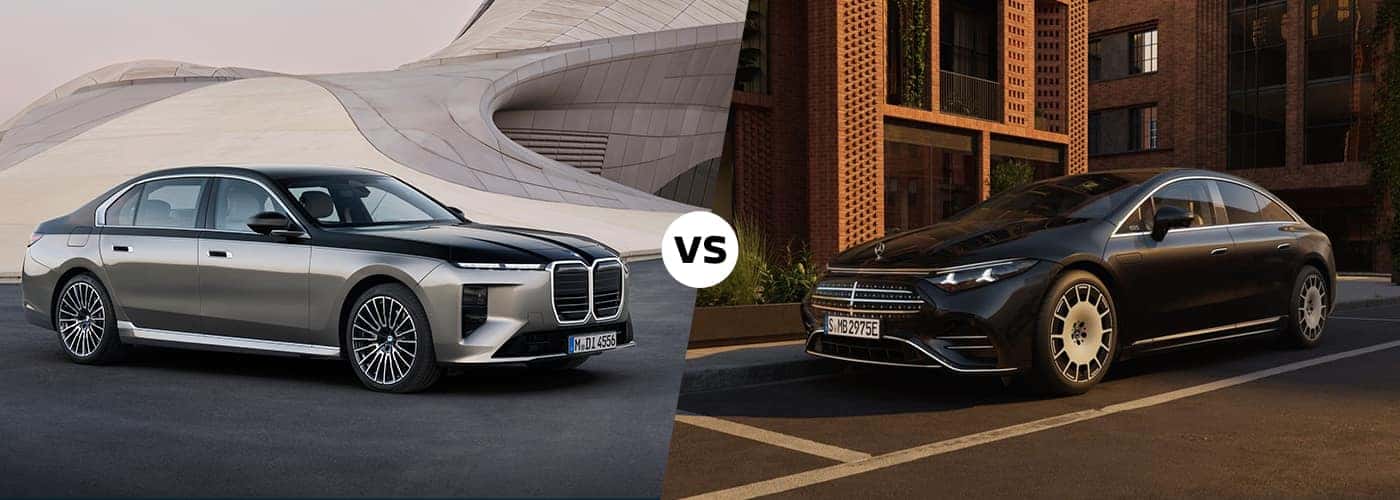
As luxury automakers continue their transition toward electrification, the competition at the top of the segment has never been more compelling. The refreshed 2027 BMW i7 and the Mercedes-Benz EQS Sedan represent two distinct visions of the modern flagship EV.
The Mercedes-Benz EQS was designed from the ground up as an electric vehicle, prioritizing aerodynamic efficiency, futuristic styling, and maximum range. The newly updated BMW i7 takes a different approach. Built on BMW’s flagship 7 Series platform, it combines cutting-edge electric technology with the commanding presence, craftsmanship, and driving dynamics expected from BMW’s most prestigious sedan.
For 2027, BMW has further refined the i7 with updated exterior styling, new lighting technology, enhanced electric efficiency, an upgraded digital experience, and even greater emphasis on rear-seat luxury. The result is a luxury EV that feels equally at home behind the wheel or being chauffeured.
So, when comparing the BMW i7 vs. Mercedes-Benz EQS, which luxury electric sedan comes out ahead?
Vs.
MSRP
Horsepower
Torque
0-60
Battery Power
10% - 80% Charging Time
Vs.
MSRP
Horsepower
Torque
0-60
Battery Power
10% - 80% Charging Time
One of the biggest differences between these two luxury EVs remains their design philosophy.
The 2027 BMW i7 builds upon the bold styling of the previous generation with a revised front-end design, updated lighting signatures, and a more sophisticated overall appearance. BMW has refined the illuminated kidney grille and introduced the latest generation of BMW crystal lighting technology, giving the i7 an even more distinctive nighttime presence.
Unlike many dedicated EVs, the i7 retains traditional flagship-sedan proportions. Its long hood, upright profile, and imposing stance create a sense of prestige that closely aligns with the expectations of luxury-sedan buyers.
The Mercedes-Benz EQS continues to emphasize aerodynamics above all else. Its smooth, cab-forward silhouette contributes to its exceptional efficiency and range, but its appearance remains polarizing compared to the more traditional luxury design language of the BMW.
For buyers seeking a vehicle that visually communicates flagship status the moment it arrives, the BMW i7’s executive presence gives it a clear advantage.
With the 2027 refresh, BMW has made one of the finest luxury interiors in the industry even better.
The i7 continues to feature BMW’s Curved Display, BMW Operating System X, Intelligent Personal Assistant, ConnectedDrive services, and advanced voice controls. The latest software enhancements bring faster processing, improved personalization, and expanded digital functionality throughout the cabin.
The centerpiece remains BMW’s exceptional rear-seat experience. Available Executive Lounge seating and the available 31.3-inch BMW Theatre Screen transform the rear cabin into a private luxury suite, making the i7 one of the most impressive chauffeur-oriented vehicles on the market.
Material quality throughout the cabin remains exceptional, with available Merino leather, premium wood finishes, crystal controls, and customizable ambient lighting. Every aspect of the interior is designed to balance cutting-edge technology with traditional luxury craftsmanship.
The Mercedes-Benz EQS counters with its impressive MBUX Hyperscreen and futuristic dashboard layout. The EQS feels more digitally immersive at first glance, but some buyers may find the BMW’s blend of technology, luxury, and intuitive operation to be the more sophisticated long-term solution.
For many luxury buyers, the updated BMW i7 strikes the ideal balance between innovation and elegance.
BMW continues to distinguish itself by delivering an engaging driving experience even in its flagship EV.
The 2027 i7 lineup offers powerful electric drivetrains ranging from the efficient i7 50 xDrive to the more performance oriented i7 60 xDrive. Both offer instant torque delivery, intelligent all-wheel-drive systems, and adaptive suspension technologies to allow the i7 to feel remarkably agile despite its full-size dimensions.
The Mercedes-Benz EQS prioritizes smoothness and comfort over driving engagement. Its acceleration remains impressive, particularly in higher trims, but the EQS generally favors serene cruising over driver involvement. The trims of the EQS are also a story of compromises. The base 450+ offers a large battery with stellar range, but compromises performance. The range topping EQS 580 offers higher performance, but sacrifices driving range.
The BMW i7 remains balanced across the lineup, with performance that doesn’t sacrifice driving range. Drivers who still enjoy being behind the wheel will likely prefer the BMW’s more dynamic character.
The Mercedes-Benz EQS continues to be one of the longest-range luxury EVs available. Its highly aerodynamic body helps maximize efficiency, making it particularly appealing for buyers who sole concern is driving range.
The BMW i7 focuses instead on balancing range, performance, luxury, and driving dynamics. Despite having a 250 kW battery pack compared the EQS 300 kW and 430 kW batteries, the i7 remains remarkably competitive in power, acceleration, range, and charging time.
For most luxury EV buyers, both vehicles provide more than enough range for daily commuting and road trips throughout California and beyond. If maximizing range is your primary concern, the EQS holds an advantage. If you’re looking for a more complete luxury sedan experience, the BMW’s broader blend of strengths makes a compelling case.
Luxury sedan buyers often value familiarity alongside innovation.
This is where the BMW i7 excels. Despite its sophisticated electric architecture, the i7 still feels like a flagship luxury sedan first and an EV second. The seating position, proportions, driving dynamics, and overall experience closely align with what BMW owners have traditionally enjoyed from generations of 7 Series models.
The EQS takes a more radical approach, embracing its identity as a dedicated EV. Some buyers will appreciate its futuristic design and liftback practicality, while others may prefer BMW’s more conventional luxury-sedan execution.
For many shoppers transitioning from a luxury gasoline vehicle to their first premium EV, the BMW i7 offers a more natural evolution.
The Mercedes-Benz EQS remains one of the most technologically advanced and efficient luxury EVs available. However, the refreshed 2027 BMW i7 has strengthened its position as one of the segment’s most complete vehicles.
With its updated design, enhanced technology, exceptional rear-seat accommodations, refined driving dynamics, and unmistakable flagship presence, the BMW i7 delivers an ownership experience that extends well beyond range figures alone.
For luxury EV shoppers who want cutting-edge technology without sacrificing the elegance, prestige, and driving character expected from a flagship BMW, the 2027 BMW i7 emerges as the more well-rounded choice.
Buying or leasing a BMW is about more than choosing the right model. Choosing the right BMW financing option can be just as important. Whether you’re considering a new BMW X5, 3 Series, all-electric BMW iX3, or another BMW model, there are several ways to structure your purchase. BMW Financial Services offers traditional financing and…
Modern luxury vehicles are expected to do more than simply transport drivers from one destination to another. Today’s BMW models deliver an intelligent, connected experience designed around convenience, personalization, and innovation. At the center of this technology is BMW Intelligent Personal Assistant, a voice-controlled digital companion that helps drivers interact with their vehicle naturally and…
What Is BMW Remote Software Upgrade? Modern BMW vehicles are designed to improve long after they leave the factory. With BMW Remote Software Upgrade, eligible BMW models can receive new software, feature enhancements, and quality improvements wirelessly, much like a smartphone update. Updates can be downloaded through the My BMW App or directly to…